
Silver Market Leverage Increasing Distress At Major Silver Exchanges
Physical Silver Is Disappearing

Rising gold and silver prices have historically acted as the primary warning signal of loose monetary policy by central banks thereby limiting such policy by forcing interest rates higher.
For more than a century, the London gold and silver markets have been the world’s primary cash/spot physical precious metals markets. Since 1987 when the Bank of England oversaw the substitution of promissory note trading instead of trading ownership of physical gold and silver bars in London’s cash/spot market, infinite promises for immediate metal delivery have been enabled in London. This allowed decades of declining then zero interest rate policies by global central banks as the market was artificially flooded with unbacked supply of gold and silver ownership claims.
But now over the past few years, global shortages of physical gold and silver have swamped the promissory note gold and silver cash market in London, and forced their prices higher as, increasingly, metal delivery has been demanded. Interest rates have been running higher along with gold and silver prices over the past several years.
Silver Critical
With only a fraction of annual physical silver demand held at primary exchanges globally and with increasingly restricted market liquidity of silver, silver’s price warning signal has been sounding, along with gold, that all is not well in central banks’ fiat currency world. Interest rates have broken higher out of a multi-decade downward channel for government bonds and are following gold and silver’s path higher.
This is a concern in the temporary debt bubble financial and economic reality that has been created by central banks.
US Silver
Over the past 6 months, ‘Registered’ silver stocks (i.e. available for delivery) in New York vaults for the CME COMEX silver futures market have been declining at a rate of 20 million (M) oz. per month now standing at 88M oz.
Note that the 20M oz. /month vault draw-down over 6 months represents the pace of net silver withdrawals (silver deposits minus withdrawals) from this vault category that has not relented due to the increasing global shortage of physical silver.
Over the past 4 days, the Registered vault stock of silver has seen 5,694 March 2026 futures contracts (28.5M oz.) stand for delivery with 1,839 contracts for 9.2M oz. of silver still open for this month.
These March 2026 futures contracts, combined, represent 37.7M oz. of silver and, if the silver is withdrawn, have the potential to leave COMEX Registered vaults with only 50M oz. of silver remaining.
Futures contract holders who stand for delivery initially receive a vault warrant for silver delivery and take some time to act - we will see how this develops and if any of these warrant holders accept cash settlement.
Shenanigans:
On February 25, 2026, CME COMEX silver trading was halted for 1.5 hours. After trading was reopened, it was announced that 31,828 contracts (159M oz.) were cleared while the market was suspended. What!?
This follows the November 28, 2025 multi-hour suspension of trading by the CME COMEX allegedly due to server cooling issues. No other users of the same data center used by the CME COMEX reported any slowdown or problems that day.
As the silver shortage problem becomes more acute, the COMEX silver market is also having increasing problems.
London Silver
The London silver market data published by the London Bullion Market Association (LBMA) indicates that London vaults held 7,036 tonnes (226M oz.) of silver - excluding silver owned by Exchange Traded Funds - at the end of January 2026.
However, London market trading seized for a period of hours on October 10, 2025 due to no London silver market liquidity despite 140M oz. of silver being in London vaults at that time.
Thus, we can estimate that approximately 140M oz. of silver in London vaults is not available to market and is simply in storage there. This implies approximately 88M oz. of silver are available for delivery in the London silver market.
The LBMA indicates that the London silver market sees over 780M oz. per day of trading in its cash/spot silver market on an active day.
China Has Silver Leverage Too
China has two primary silver markets - the Shanghai Futures Exchange (SHFE) and the Shanghai Gold Exchange (SGE).
The SHFE has open futures claims of 247M oz. of silver and vault stock of 9.9M oz. of silver while the SGE has 96M oz. of silver claims Ag(T+D) category with 14.7M oz. of vault silver.
Shenanigans:
Shanghai exchanges have suspended dozens of large silver trading accounts over the past two months as the global silver shortage has seen China’s exchange vaults experience a drawn-down to extreme levels. Details have not been provided.
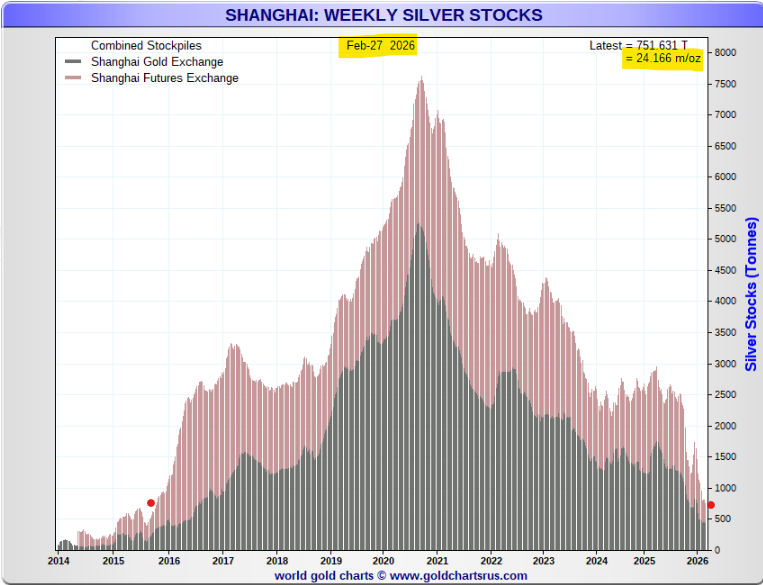
Figure 1 - Shanghai Silver Exchanges Combined Vault Holdings; source: GoldChartsRUs.com
Silver Leverage
These primary silver markets all share brutal leverage with far more claims than there is metal available for delivery.
The greatest leverage problem lies in London where the vast majority of claims traded in the London silver market are for cash/spot silver with immediate delivery on demand.
Market____________________Open Claims______________Available Vault Silver Holdings
London (cash/spot)__________2+ billion oz. (est.)________86M oz. (est.)
US CME/COMEX (futures)___March ‘26: 37.7M oz._____88.7M oz. (Registered)
___________________________Total: 577M oz._________ ''
SHFE (futures)______________April ‘26: 72.4M oz.______9.9M oz.
___________________________Total: 247M oz._________''
SGE (Ag(T+D))______________96M oz.________________14.7M oz.
__________________________________________________Total Available: 199.3M oz.
Leverage Works Both Ways
With the growing global silver shortage, the world’s major silver exchanges currently have 199M oz. of vault stock available against billions of total claims in the market. And UBS estimates that the global market will see a further 300M oz. deficit of silver supply in 2026.
Of concern is that since the onset of the attack on Iran, government bond yields have run higher due to selling of these bonds.
We can be sure that, given the global run on physical silver and gold over the past few years, this was not the result that was hoped for by debt reliant governments.
Holding assets that are nobody else’s liability are attractive in uncertain times and this increasing demand factor will likely compound the global silver market’s turnabout on the leveraged markets.
Best regards,
David Jensen

The Silver Endgame.
So, when does the suppression of silver finally end, and how will you know?
It will not be signaled by the banks suddenly "giving up" and stopping the smashes. They will smash the price until their fingers bleed. You will know it has ended when the smashes completely stop working.
Here are the three exact, undeniable market signals that will tell you the bullion banks have officially lost control of silver:
Signal 1: The "Bounce-Back" Phenomenon (Smashes Fail to Trigger Selling)
Right now, when the banks dump 10,000 paper contracts at 3:00 AM, the price drops $3, the algorithmic stop-losses get triggered, and a massive wave of retail/hedge fund margin calls drags the price down another $5. That is a successful smash.
How you know it's over: You will wake up and see that a bullion bank dumped 20,000 naked short contracts, the price dropped $2, and within exactly 15 minutes, the price completely recovered and shot higher than where it started.
This means the physical buyers (industrial whales and massive family offices) are sitting right below the market with infinite cash, treating every paper smash as a fire sale. When the banks realize that shorting the market just hands cheap physical metal to Tesla or China without triggering a cascading panic, they will be forced to stop.
Signal 2: Severe and Permanent Backwardation
In a normal, healthy futures market, the price of a contract expiring six months from now should be higher than the spot price today (to account for storage, insurance, and interest). This is called "Contango."
How you know it's over: The market will flip into severe, permanent Backwardation. This means the spot price of physical silver today is significantly higher than the paper price three months from now.
Backwardation is the ultimate alarm bell of physical starvation. It means industrial buyers are so desperate for metal to keep their factories running right now that they will pay a massive premium over the futures price. They do not trust the exchange to deliver the metal in three months. When you see backwardation holding steady for weeks across the COMEX and MCX, the paper game is mathematically dead.
Signal 3: The Vault "Redline" (The Run on the Bank)
We discussed that Registered (deliverable) silver on the COMEX is hovering around the 80-to-86 million ounce mark. While low, it is still enough to maintain the illusion of liquidity.
How you know it's over: The COMEX Registered inventory will suddenly, violently drop below 30 million to 40 million ounces. * At that level, a single billionaire or a consortium of industrial tech companies could legally demand delivery of the entire remaining exchange inventory in a single month.
Once the inventory hits that psychological "Redline," the market psychology flips from "trading" to "hoarding." Everyone holding a long contract will instantly demand physical delivery because they know the guy behind them in line won't get any. It triggers a literal run on the bank.
The Endgame
You will not see an official announcement. You will see a Friday where the NASDAQ drops 500 points, the Dollar Index spikes, and the algorithms try to smash silver—and instead of crashing, silver spikes $8 to the upside.
That is the moment the matrix breaks. The correlation to tech stocks will shatter, and silver will begin to trade solely on its physical scarcity.
-SilverDaddy
Calabasas, CA USA
Facebook Group: THE SILVER FORUM
Instagram: RealSilverDaddy
TikTok: RealSilverDaddy
X: RealSilverDaddy
SilverDaddy News Network (SNN)
Global Silver News 24/7
Great info David, Thanks